Two Main Street with David James
Two Main Street - the Mustang Adoption Academy
Season 5 Episode 3 | 55m 43sVideo has Closed Captions
David talks with the owners of The Mustang Adoption Academy.
David talks with the owners of The Mustang Adoption Academy. This Gibson County ranch helps feral horses from the wild west find new homes. After they're trained some of the horses are paired up with veterans.
Problems playing video? | Closed Captioning Feedback
Problems playing video? | Closed Captioning Feedback
Two Main Street with David James is a local public television program presented by WNIN PBS
Two Main Street with David James
Two Main Street - the Mustang Adoption Academy
Season 5 Episode 3 | 55m 43sVideo has Closed Captions
David talks with the owners of The Mustang Adoption Academy. This Gibson County ranch helps feral horses from the wild west find new homes. After they're trained some of the horses are paired up with veterans.
Problems playing video? | Closed Captioning Feedback
How to Watch Two Main Street with David James
Two Main Street with David James is available to stream on pbs.org and the free PBS App, available on iPhone, Apple TV, Android TV, Android smartphones, Amazon Fire TV, Amazon Fire Tablet, Roku, Samsung Smart TV, and Vizio.
Providing Support for PBS.org
Learn Moreabout PBS online sponsorshipFrom the WNIN Public Media Center in Downtown Evansville, I'm David James and this is Two Main Street.
The American Mustang, the horse not the car, is a symbol of the Wild West.
Feral horses; their mane flowing in the wind roam free in herds on vast stretches of public land.
27 million acres across ten western states.
These majestic animals are descendants of domestic horses brought to the Americas by the Spanish in the 16th century.
The Bureau of Land Management oversees their population in the wild.
There are roundups, and the horses and burros are available for adoption.
Some of those animals end up at the Triple E Ranch in Gibson County.
That's just outside of Haubstadt.
It's the home of the Mustang Adoption Academy, and my guests are the founder and director of the Academy, Sky Epperson and Daniella Desilva, program facilitator.
And later, we'll talk to Nick Miller, a local veteran, a graduate of the Academy and a volunteer at the Triple E Ranch.
So, guys, welcome to Two Main Street.
Good to have you here.
Sky, let's start with you.
How did a guy who grew up in Indiana get involved with these feral horses in the Wild West?
Oh, so it's a really long story, but I actually I started out with horses very late in life.
I've only probably got about 20, 21 years of experience with horses.
But my father, and my mother, for that matter, had horses when they were young.
And my father got back into horses.
I had an opportunity to move, closer to him.
And, and I have a younger brother that's about 20 years younger than me.
And they were both insistent that I get a horse.
Don't let my father pick out your first horse.
That was not necessarily what probably should have been, an individual's first horse, but it did start, a passion with me and trying to figure out the horse's brain.
Was this Crime?
No.
No, this this was my first horse.
This was actually a domestic horse.
Okay, okay.
And then.
And then later, I started to have some interest in, the Mustang itself.
I watched, a film called ‘Unbranded’, where these four young men, decided that they were going to adopt mustangs in January to one year.
And April 1st, they took off from the Mexican border and rode to Canada that summer.
Wow.
And check that one.
And I started thinking, man, you know, if my domestic horses tried to do that, they wouldn't have the hardiness, to, to, to do that.
And I was like, how, how in the world does this Mustang was that able to do that?
You know, and stay healthy and stay, weight gain and, you know, all of those things.
And so that started to the path of, you know, becoming interested in the Mustang.
I became so infatuated with the film that I actually brought it to, Evansville.
We were able to show it at one of the local, cinemas, and we packed the house for it, so that was kind of cool.
Yeah.
And then a few years later, I got this gumption that, you know, maybe, maybe I can.
Gentle mustangs.
But you were home builder, weren't you?
I was, I was, I had a business called Sentry Home Builders for about 20 years.
I had the opportunity to sell that, which freed up some time, and needed to keep myself off the streets.
So I thought, gentling mustangs would be a great thing to do.
And the rest is history.
Now, Daniella, how'd you get involved in this madness?
Oh.
Oh, well, I was riding before I was born.
I was.
Well, that's a good story.
My mom never stopped riding.
And I started as soon as I could, and, I actually started in the show world, so that was my, my lot in life was going to be I was going to compete.
And, I was kind of torn between showjumping and dressage, which is two of the main disciplines.
And then I actually I burnt out, for me, seeing some of the methods that were used in the training of the horses and participating in, in that world, was tough.
So, it just didn't really sit with how I personally trained horses, and I couldn't really see how I was going to make a living.
And, and also stay true to how I saw that I wanted to train horses.
Where'd you grow up?
I grew up in Bermuda.
Oh, really?
I did, yeah.
Oh, I know they have many horses in Bermuda.
We do, actually.
We have quite a thriving, equine population there, so.
Yeah.
Kind of.
What kind of horses in Bermuda?
All of them.
Really?
Yeah.
We know Mustangs.
I will say that because you were America's ride on the pink stand.
We do.
Oh my goodness.
Certain times of year there are rules.
We do still have rules there.
My honeymoon was in Bermuda.
Oh just beautiful.
That is beautiful island.
Wow.
So how did you end up in Indiana?
So I've bounced around, many places.
I've lived in many countries, traveled to about 60 countries, extensively, and always seemed to find horses along the way or as a part of those journeys.
I've worked in many different disciplines, but never really committed myself to that because I hadn't found like minded people.
And a way to be able to do it full time.
And so passion, this is really your guys?
It is.
So how do the veterans get involved in all this Sky?
Oh.
So, there was a time period, and doing demonstrations, that were, with the Mustang Summit group, where, I every time I turned around, I did a demonstration.
There would be somebody tapping me on the summit group.
So the Mustang Summit group is a is a it's a loosely connected, cast of characters, that, Lisa and Fear actually gathered, on her ride across America on Mustangs, to promote Mustang adoption.
And she brought us all together at the end of that ride.
And we all have the same passion.
We all have this passion to, promote the Mustang, get the Mustang adopted.
Successfully.
Train the Mustang in a way, or educate the Mustang in a way that is gentle and kind.
And that's where the veterans come in.
And then they also have a mental, a mental health aspect, too.
So there was people in this group that were not only do what I do as far as gentle aiding the Mustangs, but there was also mental health professionals, there was artists, authors, etc.
And so we travel the United States, and we do older demonstrations.
Like for our part, we do demonstrations where they'll be 6 to 7 or 6 to 8 people like myself.
That will gentle mustangs over a few day process so people can see and evaluate how to do that.
And, it also gives the people that moment if they adopt a mustang and they get home and they have their own moment, as I like to call it, where suddenly they're like, oh, I don't know anything about horses because this horse doesn't react the way, you know, all my other horses have now they have a group of people that they can call and, and, call for help now.
Veteran service program.
How did you get involved in that?
Guys?
Daniella, are you program facilitator this.
So I actually happened upon these guys at one of the summits, and a big draw that for me was the mental health aspect.
That's a lot of my background is mental health.
I volunteered for about 20 plus years with a program that does more hypnotherapy.
And equine assisted therapy with kids with autism, down syndrome, etc.. I hadn't personally been involved in any veterans programs.
So they have panels at these summits, and a lot of the people that have the different programs will get up and speak about their program.
And I just happened to have some time in between at the summit.
I walked up there and there was a group of program facilitators and owners and veterans that were sitting up there talking about what they do, and the parallels between the Mustangs and the veterans and how it helped them.
Kind of re assimilate back into civilian life.
And I mean, how can you not be hooked after that?
Now, of the Triple E property, I visited your ranch, near Haubstadt.
Tell me about the ranch.
The name triple E. What is that?
And so, I was blessed with triplets, about 23 years ago, a little over 23 years ago.
And so that is where the name of our ranch came from, thank God.
Wow.
Well, that's another story.
If you can handle triplets, I think you can handle mustangs.
Horses definitely know.
So how many horses and burros you have there?
I mean, no girls.
Do we do so?
Of course.
Of course.
Mustangs and burros come, come and go at the ranch.
But, you know, with adoptions.
But there's currently, 21 horses and burros, there at the ranch.
And now some of those are our personal horses.
And they will have forever homes there.
But then some of them are, over half of those are mustangs that, as they are, settled, and ready to be adopted, become adopted.
I noticed when I went out there your mom was also in the one of the barns.
Yes.
That's, mother mucker, as we like to call her.
So, I guess, she's.
This is her.
Does she live there?
She does not.
Okay.
My mom had a ten mile rule.
She didn't want to live within ten miles of me when she moved closer.
Okay, but she, does come three times a week.
And volunteers and she, 80 years old or so.
She, mucks pens and, mixes feed as you saw and, jumps right in there and, helps, in fact, sometimes we, probably have to hold her back a little bit.
Well, she seemed very enthusiastic about it.
Yes, she.
I'm sure she loves those horses as well.
So, when you started adopting these mustangs, how did that first go with that first group?
So the first the first, I brought in two together.
One of those, horses became, my heart horse.
went to, Ewing, Illinois.
First of all, there's a there's a facility in Ewing, Illinois, ran by the Bureau of Land Management, where we get most of our Mustangs from.
And anybody that wants to adopt an unhandled or untouched Mustang can go there and actually pick up, a mustang.
It's only about an hour and a half from our ranch.
Just a big corral of thousands.
Yeah.
So they have, I don't know, probably, 10 to 12 pens.
And then they also have some Anchorage where the horses get, turn, turn out.
And when I say pens, their pens are, you know, very, very, very large size, right?
No, not mount a pen for, you know, one horse with 20 in it.
So you brought home some horses?
Yeah.
And, first, I guess, is the horse that I first was drawn to.
He was a, 15 year old, male horse.
He had been a stallion in the wild for 12 years.
Before he was rounded up, he would have been called what was a three strikes horse and that he had been up for adoption three times and nobody, picked him.
I actually, and he was big for a mustang.
And Mustangs are not terribly small, but they're also not known for their large size.
So Specs was a, over six, probably approaching 17 hands.
But not quite.
There.
So it was intimidating.
And I also, so I actually called three different horsemen and women while I was there to have them try to talk me out of taking this horse.
Because I didn't think that the, you know, something that had been a stallion in the wild for 12 years was probably necessarily what I should be gentling.
The first go around.
But talking Sky out of doing anything that he's already got his heart set to is not an easy feat.
Okay, so, how does it go with this?
So, so, I mean, Specs and I had so much fun and, you know, it became, and he taught me so much that he taught me, hey, that I can do this.
He taught me that there had to be some other ways that I needed to learn to do things, and that the Mustang wasn't just like our domestic horses.
And, and then he eventually he did go to an adopter.
Which, before, if probably that adopter hadn't, hadn't made arrangements when she did, I probably would not have ever been able to send him away.
But she adopted the horse and, I couldn't remember the day that he went away.
I did a social media post that talked about sending my, you know, the old timers talk about you get one horse in a lifetime.
That's your horse.
That's your heart.
Yeah.
That's your heart horse.
And I saw you kind of broke up with that one.
Yeah.
And so I took your baby I sent him, I sent him sent him away.
And I didn't have much of a social media presence at that time, but even that little, post got a lot more activity views, than what was most did.
And then about six months went by and I got a call from an adopter and she said, you know, I've been blessed, I've become pregnant.
But my husband thinks that Specs is a little bit too big of a project for me of while I'm pregnant and raising a young one.
Would you want him back?
And so I was like, absolutely.
You give me two weeks, I got to make some space.
I've got a horse that's got to go out for adoption soon, and I'll come.
I'll come pick him up and, so we were we're able to go back and, and, bring specs home.
And we started to, you know, get, get reacquainted.
I'll do I will back up because Specs was a pretty smart horse.
And so the day that I loaded him in the trailer, the send him away, he loaded hundreds of times by this point in time, he had it down pat.
When I brought him up to load, he did something he never done before, and it seems like Specs knew what was going to happen.
He raised up his right front leg as high as he could, and he slammed it down on the trailer door, and he refused to load for about a half hour.
And then once I did load him, I took the halter off and said my goodbye.
And as I was leaving, I was trailing the lead rope behind me and watched him pick up his foot and step on the lead rope.
You know, which meant that I had to go back to the trailer and, you know, tell him that, you know, these were good people, and I was going to be alright.
Let's go full circle now.
You got Specs back.
Is he still there?
He is not.
Unfortunately, Specs passed away about 30.
Oh, about a month after he came home.
Okay, okay, Daniella, let's have you pick up.
Do you have a heart horse you want to talk about?
Oh, they're all my heart horses so far.
I had my heart horse.
I was I was very fortunate when I was younger, I he came across me.
He was not a mustang, so.
I know I'm just waiting for my heart mustang.
But, whether they are your heart horses or not, they take a little piece of you when they go.
And as Sky likes to put it, they also leave a little piece behind with you.
So we do this for them.
And, you know, with the story of specs, Sky, let him go because it was the right thing for the horse.
So that is the pursuit of all of this.
It's the right thing for the animals.
Now, you talk about brain based horsemanship, you guys.
And, would you describe that as a game changer?
Oh, gosh.
Absolutely, absolutely.
So, working with Mustangs, I had been, successful at the start.
And was and I had helped hundreds of domestic horses, you know, become great horses, be able to be successful in domestic life.
And the same with the Mustangs.
And then I got sent a horse, by the name of Crime.
Should have been a first clue that things weren't going to be easy.
But, and Crime and had some previous human experiences, but so he, he not only still had the wild in him, but he also had some really bad educational experiences from humans.
And, I would say about 40, 45 days working with Crime when I discovered that, you know what?
I'm not helping this horse.
I'm actually making him worse.
And since you all know that I'm emotional already, now, today, with my story, I lay down and I cried in Crimes pen.
I couldn't understand why I couldn't help him.
I'd been able to help all of the others.
But, as we all should do when we're trying to help, horses into a world that they're not necessarily designed to be in.
I kept searching, and a friend of mine introduced me to a gentleman by the name of West Taylor, who had become a disciple of Doctor Steve Peters.
Who developed brain based horsemanship.
And, Doctor Peters was a or is a neuroscientist, brain surgeon, autistic.
And got horses later in life similar to me and started to watch how people were working with his horses to help him and, there's got to be a better way.
So he started studying the brain of the horse, and, he discovered, that there were so many things that we were doing right as horse people.
But there was also many things that we were not totally getting.
And so after a couple days of spending time with West, I brought those, tenets of brain based horsemanship, probably pretty rudimentary, back to the ranch, back to Crime in particular.
And seven days later, I had an entirely different horse.
And, 42 days later, he went home to an adopter.
And so we went from a horse that I didn't know what the heck I was going to do with, because I couldn't go to an adopter to a horse that is successful today.
It was a commanding horse Pasado?
Yeah, Pasado is one of our horses too, which is the Spanish slang for ‘pain in the butt’ Did you know that?
I did.
Yeah, I did, that's how he got his name.
Yeah.
So Pasado-- Pasado when he first came to us.
We were his fourth home, in two weeks, and so Pasado when I unloaded him in our place, I told him he didn't ever have to go any place else.
And Pasado, you know, if you can imagine trying to find a safe way to a safe way and a new life, and you're in four places in two weeks.
It's not it's not a great, you know, story, and, but.
So he didn't really want anything to do with me in the start, unless I sit down in the pen next to him.
Why?
I was working with Crime, or I stood, you know, next to.
They were penned up in pens adjoining, and he would often come over and steal my hat as I was standing there working with the other horse.
And, so I purposely, you know, and I usually work with the horse for a while before they get a name.
And, so I was trying to determine, slang for pain in the butt.
And so that's where I came up with.
And I have a daughter that is a Spanish teacher.
So that kind of you go, you know, she appreciated that, I'm sure.
And and he is a grew la horse, color wise.
And that's also Spanish.
So I thought it all kind of went together.
Now, these are horses.
Daniella are identified, aren't they?
When they're brought from the round roundup.
These have an ID?
ID they do.
They have a freeze brand mark.
What's a freeze brand mark?
So it's a, mark.
A number that they put on the side of the horse's neck.
And they it's they do it with a, similar to if you were burning off a wart or something like a hot brand.
No, they don't do that anymore.
They it's much more humane the way that they do it.
And it's much, longer lasting.
So you can always identify the horse from their freeze brand.
And at the time of, of the roundup, they tag them as well.
So they put a rope with, little plastic chip on the bottom of it with the last four numbers of their freeze brand.
So that's how you identify them.
And it's actually it allows us a really cool moment when you bring in one of the horses for the journaling program.
It's an amazing moment to take the tag off, because you've gotten to the point where they allow you close enough and they trust you enough to be able to do it.
And we, at that point, that's the way that we work at the Mustang Adoption Academy is that's when we give them their name.
And say that they have chosen to step into domestic life with us, which is a really, really good moment and definitely elicits some tears.
So let's go back to the roundup process.
It's kind of controversial.
The Bureau of Land Management has, you know, all these millions of acres of public land.
And I think it was like 82,000, horses.
I think that's the last answer that I had on those public lands.
And the because they round them up because, I guess because they're afraid of the overpopulation and, anyway.
But they have helicopters that they round them up with that's controversial because there's a stampede and some of the horses sometimes are injured during the stampede.
So anyway, so they, they round them up and then they send them out to these, these like little satellite, corrals around the country.
Yeah.
That work.
Yeah.
So throughout the country there's places the much like the, the facility we talked about in Ewing, Illinois, most of them are in the West.
But, and that is where the public can go and, find their Mustang or like, in our case, a lot of our adopters will they'll, they'll contact us and say, hey, I would like to get a gentled Mustang.
I don't want to necessarily, especially for the first go around.
Adopting on a handled Mustang, I understand.
You know, a lot of them understand that they are different than our domestic horses, and they need to be handled a little bit differently.
And so a lot of times they'll contact us.
We'll actually, go and make the trip together later.
You'll probably get, hear from Nick.
He's adopted a couple of our, Mustangs and him and I went to Ewing, Illinois.
Picked out the horses together, and then brought them home.
But you can do that in facilities throughout the United States.
Now is there a cost involved in this adoption process?
Yes.
So, $125.
Adoption fee, will go to the Bureau of Land Management.
And then through our program, there's a $650 fee or donation to our nonprofit, the Mustang Adoption Academy.
That's for the training.
Yes, yes, yes.
And we're only able to keep that so low, because of a, great donation that came in, a little.
Oh, about a year and a half ago.
That's allowed us to do doing it that low, low price.
Daniella, tell us about the volunteers.
I know they're very important.
They are, there's only two of us out there full, full time, and we can't.
We couldn't handle 20 plus horses.
So we have an amazing group of volunteers and, they do everything from mucking the pens with us to learning brain based horsemanship to work with the horses.
And then we have admin volunteers.
So people that really they love the horses and they support what we're doing, or they have family members that are veterans and they want to support in some way, but they either can't or, don't particularly want to be fully involved with the horses themselves.
So and that's equally as important.
So we have some, some wonderful volunteers.
We also run a student volunteer program, which, is really blossoming.
So we taken obviously with parental permission, we take in student volunteers and they come to the ranch, as their studies allow.
And we actually yesterday took two of them up to the Saint, Saint Mary of the Woods College, up in Terre Haute.
And they got to see the equine studies program.
Sky was a guest lecturer up there.
So we got to bring two of them with us, which was a really neat experience for them.
And it was really nice to see what they learned, about brain based horsemanship and apply that to a situation where they might go, they might go to college there, and these might be their peers in the future.
And for them to see that there is a path, for them in the equine world, what about veterinary care?
I mean, are they these animals when you pick them up, are they checked out and everything?
Yeah.
So the Bureau of Land Management does, make sure that before they come to us that they've had the immunizations, and that they also have had some basic, foot care if needed.
And, do you want them to as well?
And then once they come to the ranch, that becomes our responsibility.
So it's very important to us to gentle them still in a very, very kind manner, but also do that as quickly as possible, which are two adverse things.
They're going together.
But if we have an injury or a sickness, it's important to be able to handle that, that horse to be able to help it.
Okay.
Well coming up we're going to learn more about the veterans program at the Mustang Adoption Academy.
As, Nick Miller joins the conversation.
And how he has benefited from bonding with these horses and his advice to other veterans who may be struggling.
I'm David James, and we'll be right back with Two Main Street.
Welcome back to Two Main Street.
I'm David James and my guests are sharing the mission of the Mustang Adoption Academy.
Not adopting cars, but feral horses from the wild west.
Sky Epperson is the director and founder of the academy, located in Gibson County, just west of Haubstadt.
Joining Sky right now is Nick Miller, who has completed the Academy's program for veterans and is now an active volunteer at the triple E ranch.
So, Nick, let's go with you.
How did you hear about the veterans program at the Mustang Adoption Academy?
So, Sky was developing the veterans program, and I was actually the first guinea pig.
My wife loves horses.
I didn't care one way or the other, but we got involved with them through a mutual friend, and, we sort of hit it headlong together and kind of found a way through.
And he helped me and I helped him, and it was an excellent experience.
Well, tell me about that.
That trip, to the corral in Illinois to see that first adopted horse.
What was that like?
Well, this was a little bit after the veterans program, but through the veterans program and enjoying being around Skye and the horses, me and the wife decided that we were going to adopt two of, well, let's give you your wife's name.
Amy.
Let's talk for Amy, because my wife would say that she's not just a wife.
Yeah, yeah.
So, yeah, you and Amy go to see the horses, right?
Yes.
And, ended up picking two of them out.
Oh, really?
Yes.
So I have two mustangs now, yeah.
Well, how do how do you pick out a horse?
That is a tough thing to do.
I had a big list and I narrowed it down, but realistically, it came down.
You can almost just look in their eyes and go.
You're going to come home with me today, aren't you?
I, I always people ask me that and I always tell them that they're going to choose, you know, really they do.
There's a kind of a connection there.
Yeah.
There is the bonding there.
Yeah.
I've actually had horses where, you know, we talked about that tag.
You know, it's hanging down their chin and on their neck.
And I can remember a horse, that it took me about 35 minutes to be able to read his tag, because every time I moved, he moved to see me.
And so I could never get that side view of him to, to get the tag number and, you know, and I was playing cat and mouse with him, you know, because we can't at the, at the facility, you can't go into the pens with them.
You have to stay outside of the pens.
And, you know, it was an interesting, you know, but he was fixated on me.
And I think that often happens, to people I know.
Daniella, the first time that she, went to Ewing, she was asking me the same question.
How are you going to know?
And I said, they'll pick you.
You'll know.
Okay, so Nick and Amy pick out two horses.
They go back to the academy to be gentled, right?
And how long did that take?
One of my horses.
What was that?
Maybe 90 days.
She did really, really great.
The other one is actually still there.
Every every mustangs different.
And she was a little bit older, and she's got some, some neural pathways we're still working on.
She's doing really good.
We'd love to get her home as soon as we can, but he's working on her, and she's.
She's coming along.
So do you have, like, a ranch or farm or.
I have about 12 acres.
Okay.
Yeah.
So they have plenty of room to roam around.
Let's go.
Do you have any other animals?
Oh, just the dogs.
And cats.
Okay, so, how is, this experience with the Academy?
I know as a veteran, does it help you kind of cope with the things?
Yeah, well, I'll tell you it.
So.
So my experience is something that I didn't know anything about horses when I went there.
Nothing at all.
When I got there, I was borderline concerned and sort of scared of horses because they're just such an intimidating animal.
Very, very large.
So no experience with the Mustangs, especially.
Sky, very levelheaded trainer.
We'd find something I could do.
And then he kind of expand my boundaries more than anything.
So that helped me tremendously, because I really shrank away from stuff when I came home from Iraq, started pulling away from people and society, and I really didn't want anything to do with it.
So Mustangs especially have a really interesting way of showing your inner thoughts and fears and and your struggles.
Nothing at all can be hidden from a mustang.
You walk in the pen with them and they see right through you everything that you have going on.
So while participating in the Mustang service program, I learned that horses is always looking for safety.
That is what they're after.
That is their come down to the moment of I feel good in this moment.
And they're kind of like they were prey animal at one time when they.
Yeah.
Oh yeah.
In the West.
Yes.
Absolutely.
So if the horse is acting up running around fighting, they're just they don't feel safe.
So something that I got to asking myself because with that I'm like maybe, maybe I have something going on.
Nothing that he talked about.
This isn't a talk therapy thing.
It's just you're just working with the horses and they show so much about you as you're working with them.
So something that I had to ask myself was, well, do I not feel safe?
And it's not a question that I've ever asked myself.
So when I started talking about that, in, you know, in my head, you know, looking in the mirror at home, I'm like, what am I doing with my life?
It's so I was separating myself.
I was running away from people that loved me.
And I finally asked myself, am I safe?
And the answer was a resounding no.
I didn't feel safe in society.
I didn't feel safe in my own skin, and I just didn't feel safe around anybody.
So just sort of an inner reflection was really the big first light bulb moment for me, working with the program now, you went to Iraq with the Evansville based guard unit.
I did the 1/63, you know, how long were you in Iraq then?
We were in Iraq for ten months for that deployment.
So I only did one deployment in 2008.
So what was that experience like?
What did you guys do?
I was with a company that ran convoys, security.
Few other companies did other things.
But my job was convoy security.
We kept the trucks safe going back and forth.
Civilian trucks for supplies.
Do you have any, frightening moments?
We had some interesting moments.
Nothing.
Maybe for radio time.
Well, but enough to, you know, you don't forget them, do you?
Don't forget those moments ever.
You don't.
I think I think one of the things and it kind of touched us on this, but one of the things that civilians often don't understand about, about veterans is they go through a boot camp for 8 to 10 weeks of boot camp, and in that 8 to 10 weeks, basically everything is torn down about civilian life, are torn out of them and put in place What the military needs from them.
And safety is now found in the military because, well, because you know, how everybody around you is going to react all the time.
Our failure, with the military is, is that they don't do anything.
They don't spend any they don't spend 8 to 10 weeks to bring you back into civilian life.
And so now they're thrown into civilian life and everybody thinks, well, gosh, they knew this before they went into the military.
What's the big deal?
Well, the big deal is, is again, safety for many people.
And they don't now they don't understand what the guy next to them and how they're going to react or the or the life at home and how they're going to react.
And so that it's not.
Getting the mission done.
In civilian life, it's much different than getting the civilian the parallel with the internals, too, because they really don't know what's going on either, because they're on edge.
They're in a new environment too.
So you guys are trying to bond.
Absolutely.
And you have bonded with at least one of them, right?
I have I've actually got a-- I wouldn't say a heart horse, but the one, one horse that at the ranch was the very first horse that I looked at and I thought, man, I relate to you, Guy.
So his name's Whiskey, okay.
And he was has a very traumatized background, multiple different trainers, owners.
He has some injuries that he's trying to hide from you and he gets it can be a bit aggressive, rescued out of the same kill pin twice.
Oh there's a kill pin.
Yeah.
So not there once but twice.
So tell me what the kill pin is.
So, slaughter in, Mexico and Canada of the horse is still legal.
It's not legal anymore to do that in the United States, but, the United States government will let a, quota of horses go out daily into, especially Mexico for slaughter.
And so most of those animals start that pipeline to slaughter out of, horse auctions, and they'll be the cheap horses that sell, at the auctions.
And the people don't adopt them and those.
And then just after a while, they're in that pen, you say, yes.
So I'm loving so, so Whiskey and brought him to the Mustang Adoption Academy for Sky to work with.
Yes.
So when I got there, knowing nothing about horses and I see Whiskey, Sky’s words to me are, ‘oh, don't, don't mess with that horse, he’s dangerous’.
So obviously my first thought is I'm going to go get to know this horse.
Well that's a challenge because maybe there was a little psychology going on there.
You know, that's how he works.
I mean, Whiskey had a really great moment one time.
So he always stays away from everybody, humans.
And he's gotten so much better now.
But, it was feed time in the evening and he said, go get Whiskey.
I'm like, oh my gosh, I can't go get Whiskey.
He don't want to come.
So I went out there and we were out in the field and he stopped and he looked at me and I looked at him and like in my brain, I'm going, what are we doing?
Can we do this?
I don't think we can do this.
And I'm like, come on, buddy, let's go.
And he just started following me.
Just.
And it was such a connection that, and I didn't have that connection for so many years as such.
I just, I know personally and I know a lot of other veterans who have such a problem having a personal connection with people because it goes back to safety and trust.
Sure.
And that's something that I struggle with.
And so Whiskey was the first meaningful connection that I had in 15 years.
Well that's going to be very satisfying for you.
Oh well the so that moment was, was was a heck of a moment at the ranch because I could not get that connection with Whiskey.
Not in the same manner that you know Whiskey basically follows him for five, 600ft I would guess through, through a couple different gates, to make it, into the barn lot.
And I could do that was Whiskey, but it would take me about 15 to 20 stops and loose loss of connection with him to do that.
Whiskey sensed the vulnerability with Nick.
Yes.
And there was that bonding moment.
Absolutely.
Wow.
Now, Sky.
There's a quote on your website saying veterans don't want to sit and talk about the bad things that have happened.
They just want their lives to get better.
Your program allows them to adjust without being victimized or threatened.
And, of course, we all know about the suicide rate among veterans.
So this is a very important program.
Yes.
You know, there are 22, American veterans that commit suicide daily.
Most of them have been through a variety of, mental health programs.
By the time they end up with us, we do not treat them.
Treat this as a traditional talk therapy, program.
We're going to teach brain based horsemanship.
And through the teaching of brain based horsemanship and working with the mustangs and some of those parallels between the veterans and the Mustangs, the veterans often find their own path in their own way, sometimes with some nudging from us or, and definitely some nudging from the Mustang.
And, we just see great things come out of the program.
And, you know, not only has Nick have we seen the success stories from Nick, but but we've seen success stories of, I had a young lady, one time, I asked her to do something with the horse.
She didn't feel safe doing that.
She said no, and I didn't think a whole lot about that at the time.
I just found something that she could do with the horse.
And at the end of the session, you know, I kind of asked, you know, or we ask kind of like, hey, what did you what did you get out of today's session?
And she said, I was able to tell a man, ‘no’ for the first time, and, you know, so often you don't even know what's going to come out of the program, you know?
And that's that was a cool moment.
You know, Nick, have you been able to share your experiences with other veterans?
Oh, absolutely.
I have shared with many veterans, but something that, I always tell veterans is the Mustang service program.
It gives the veteran the ability to see a another life form that's survival based, go from just fight and flight, just trying to run away from everything.
And they're watching it actually come and get involved and be curious and open.
So talk about parallels.
They're definitely veterans want to just get away from things.
And being curious is so difficult as a veteran.
And it also gets it gets the veteran has to have the ability to interact with the Mustang and actually influence them in a really positive way, where I at times have had really terrible home life problems just because I caused them, you know, my reactions or, and anger, these feelings that I was holding on to mustangs, they just live in the moment and you're there with them and you mess up and that's okay.
Just come back later.
They don't remember.
Yesterday's wasn't a problem.
Tomorrow's not a problem.
Just today.
And that is something that I really benefited from.
And I've told others that they can easily benefit from it.
And you can see that progress happening.
Absolutely.
Very rewarding.
Definitely.
Each horse, of course, does have a personality, as you guys have, have noticed and seen, what's that like dealing with the horses personality?
Does it take a while to understand them?
It does to some degree or another.
But like veterans, all horses are different.
And at the ranch, there's so many mustangs in different stages of training.
Okay.
So you add their personality on top of what they can do and not do.
So it's like going to a family reunion.
I mean, that's your and your uncle like, and you got your name on it, but it's a little bit different.
So you're working with him and you're learning and it's and you really have to connect with him to understand why they're different and what you can do with them.
Nick Miller, you’re a volunteer at the Academy.
What do you do as a volunteer?
So when they have their Mustang summits and they go out of town, or they go to the college and do their, their, their outreach, me and other volunteers come in, we'll mark and we'll feed and we'll take care of the horses while they're gone.
And there's some volunteers that are spending quite a bit of time out there that help gentle the Mustangs as they come along.
And you certainly have benefited from this program.
I think that's obvious.
Absolutely.
Okay, Nick, thanks for sharing your experiences, with these, feral horses as, both veterans and their horses adjust to a new life.
Yeah, definitely.
Thanks a lot, Nick.
Now, still to come, Daniella Desilva returns to the conversation with Sky as we learn more about the academy, the importance of training these horses, and adoption returns, the do's and don'ts when adopting a mustang, and the future of these horses in the wild.
Much to talk about.
I'm David James, this is Two Main Street.
We'll be right back.
Welcome back to Two Main Street, I’m David James.
My guests are here to tell us about the Mustang Adoption Academy in Gibson County, where feral horses are being paired with veterans.
It's a worthy mission and a passion for the founder and director of the academy, Sky Epperson, and program facilitator are a Daniella Desilva.
Let's go back to the veterans program.
Daniella mentioned it's free to the veterans.
Yeah.
We really wanted to let everybody know that, we are a nonprofit.
And we are able through that to offer the Mustangs of Service program free to veterans.
And how many weeks is the program?
So, you can come out if you just want to come out for a day or an hour, you're welcome to do that and maybe evaluate whether you want to go on with the program or, and the program itself, if you want to do the full program.
It's kind of a 12 to 16 week program.
If you're coming out once a day.
But we also can kind of, schedule that to your schedule.
So we've had people that maybe they want to do a five day intensive where for five days in a row, we just we go at it and teach all of the same things that we would teach over a 12 to 16 week program.
What's that bonding moment like between a veteran and a mustang?
When you when you see that light bulb go off?
I think we probably get just as excited as they do.
Yes!
There it is!
So that's very rewarding, I'm sure, for you guys to see that happen.
And it changes their lives.
Oh, it does.
And the great thing as horse people is seeing people who don't necessarily have that background come in, whether that's the veterans, our student volunteers, our other volunteers, come into the program and they don't need to be horse people to get something out of this.
Well, and they're starting to share your passion.
You feel that moment now.
There is a romantic notion, of course, of adopting a mustang and riding off into the sunset.
And that always doesn't happen, at least not right away, does it?
Well, you have to make the pens first.
You gotta pay your dues, right?
Absolutely.
That's part of it.
But it can be a difficult process.
Yes.
Unfortunately, there are mustangs, that get returned to the bureau we talked about.
There's adoption returns.
Yeah.
And, I mean, recently with the Bureau of Land Management, actually, reached out to us.
They were, having four Mustangs and surrendered back to them.
And, at first, they just kind of asked us.
Hey, would you would you be available to pick them up for us and get them back to you?
And of course, we were like, well, we have room for two, so maybe we'll take a couple of them.
We brought four back.
Our thoughts were, well, we're going to we're going to pick the, the two, easiest ones and we'll keep for ourselves.
Maybe you want to tell the rest of the story on how we did the exact opposite.
As he said before, they choose us.
Okay.
So, and then we ended up keeping all of them.
We managed in place one with another trainer that we've worked with before, up near the Chicago area, and we still have the other three.
So they have joined the program.
Stallions and mares.
Which ones are easier to work with?
So we have geldings.
They, the BLM no longer adopt out stallions.
They don't go.
They don't.
Okay.
So they're fixed.
Yes, yes, yes.
Okay.
But you know what?
It's everybody has their own opinion.
Horse people, they will tell you that mares are temperamental and geldings are much chiller.
But they all have their own personalities as do we.
And sometimes they connect more with some people than others.
But I will tell you that both of them, no matter what the, the cork is or the thing that they might be going through, it all goes back to safety.
And that is one of the tenants that you will quickly learn about, at the Mustang Adoption Academy is every decision that a horse makes is about safety, and I like to question him on that from time to time.
I'm like, See this example?
How is this related to safety?
It's a bit like that.
My big fat Greek wedding.
Like, give me a root of the word and I'll show you how it's Greek to safety.
There's also the safety of the handler, too.
Well, that helps understanding them, of course.
I mean, that's our number one priority at the ranch.
And we will say that any time someone comes into the program, or a volunteer, it's always about safety for us and for the animals when you get what you guys working with them, you're very deliberate.
There's no sudden movements and you kind of let them come to you.
We're pretty relaxed group and we we're very collaborative there.
But we do have some very explicit rules that must be followed for us and for the horses.
But once you understand what we're doing and how the horses operate and their brains operate, because this is a science based horsemanship form of horsemanship.
So once you understand that, it becomes second nature.
So there's some basic do's and don'ts when approaching these animals don't get stepped on.
That's a good one.
Yeah.
I mean one of the most important things.
And I mean it kind of goes into the, the veterans program.
This as well is, is really starting to learn the cues of what as a horse climbs the tolerance scale.
And so we want to work below tolerance.
So, but we want to also be expanding boundaries at the same time.
How to do that is we want to live in this little area that's just below tolerance.
Over tolerance is where are you going to see the flee, the fight, the freeze.
Things happen.
We don't want this.
We don't want to be in those areas.
So if we can learn to watch the horses speak to us, tell us as it's climbing up that scale, then we want to stop or expanding the boundaries at that point in time, release our pressure and let that horse return to safety.
Let's wrap this up.
Any future plans for the Academy?
Always.
Future plans for the academy?
We're always wanting to expand the, the Mustang and service program to be bigger, be able to help more veterans.
We would like to be able to get more mustangs, gentled.
All of that, costs money.
And-- How are you funded?
We are funded, by mainly private individuals right now.
Private individuals, some companies, make donations, to us.
And those go directly into, feeding the Mustang, allowing us to, to be able to work with the veterans, and keep the services to the veterans for free.
We also handle, or do, some fundraisers every year at the ranch.
My guests have been Sky Epperson, founder and director of the Mustang Adoption Academy at the triple E ranch that's just west of Haubstadt in Gibson County.
And Daniella Desilva, program facilitator.
Thanks a lot, guys.
And if you haven't seen a mustang up close, you can see that wild spirit in their eyes and in the way they move.
You want to add anything else to that description of a wild Mustang?
Oh, they can be really goofy to want to hear about how good looking they've been.
Oh, they're all sorts of fun.
They're very inquisitive, very curious.
They like to pick things up and play with them.
They love playing with Sky’s hats.
Oh, really?
Well, we heard what's the story about that?
We're even teaching one of them to paint right now.
Oh, well, that's an interesting story.
Yeah.
Well thanks guys.
This has been a great conversation.
And, continued success with the Mustang Adoption Academy.
Anything else you want to add?
Thank you so much for having us.
You can you can find us at the-mustang-adoption-academy-dot-com.
We're also on Facebook and Instagram as Mustang Adoption Academy.
Thanks again.
Thank you so much.
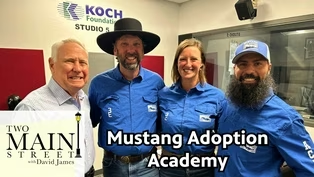
Two Main Street - the Mustang Adoption Academy Preview
Preview: S5 Ep3 | 2m 57s | David talks with the owners of The Mustang Adoption Academy. Full Episode at WNIN.org! (2m 57s)
Providing Support for PBS.org
Learn Moreabout PBS online sponsorship
- News and Public Affairs

Top journalists deliver compelling original analysis of the hour's headlines.

- News and Public Affairs

FRONTLINE is investigative journalism that questions, explains and changes our world.











Support for PBS provided by:
Two Main Street with David James is a local public television program presented by WNIN PBS