
Boil That Cabbage Down
Season 11 Episode 1106 | 25m 17sVideo has Closed Captions
Reclaiming the Black roots of the banjo.
A novice banjoist embarks on a journey to uncover the instrument’s overlooked Black origins. Through lessons, history, and community, she confronts the banjo’s complex legacy, culminating in a celebratory jam session that reconnects past and present.
Problems playing video? | Closed Captioning Feedback
Problems playing video? | Closed Captioning Feedback
Support for Reel South is made possible by the ETV Endowment of South Carolina, National Endowment for the Arts, and Wyncote Foundation.
Boil That Cabbage Down
Season 11 Episode 1106 | 25m 17sVideo has Closed Captions
A novice banjoist embarks on a journey to uncover the instrument’s overlooked Black origins. Through lessons, history, and community, she confronts the banjo’s complex legacy, culminating in a celebratory jam session that reconnects past and present.
Problems playing video? | Closed Captioning Feedback
Where to Watch REEL SOUTH
REEL SOUTH is available to stream on pbs.org and the PBS app.
Providing Support for PBS.org
Learn Moreabout PBS online sponsorshipThere is something there.
Go back.
Go back.
Go back to this sound.
To play for the trees.
This musical refuge.
(ethereal synth tones) (crickets chirping) (pensive banjo music) I saw it one day, this image.
Were they hidden between mountains, dancing on solid ground?
Did they play for the trees?
Bright as day, that sound emerging from a round body and long neck, the player resting on its strings.
And suddenly, I felt as though I had found what I was missing.
A distant past became present.
Something's there, maybe resting in the neck, surviving in frets or lasting on the bridge.
Go back, return.
Go back, return.
Go back, return.
Go.
(music fades) - Here's Roy Clark, the famous Hee Haw banjo picker, the whole Hee Haw gang in "Bile Them Cabbage Down."
- [Musician] A-one, two, and a-one.
(fast-paced banjo music) ♪ Bile them cabbage down, boys ♪ ♪ Turn them hoecakes 'round ♪ ♪ The only song that I can sing ♪ ♪ Is bile them cabbage down ♪ (energetic music) - [Candace] Where do we start?
A clear history is a privilege we don't have, so I guess we'll start here.
(upbeat bluegrass music) ♪ Bile them cabbage down ♪ ♪ Bake the hoecakes brown ♪ ♪ The only song that I can sing ♪ ♪ Is bile them cabbage down ♪ (music ends) (record player starts) (fast-paced banjo music) ♪ Out behind the hen house on my knees ♪ ♪ Thought I heard a chicken sneeze ♪ ♪ Only the rooster saying his prayers ♪ ♪ Thanking the Lord ♪ for the hens upstairs ♪ ♪ Bile them cabbage down, boys ♪ ♪ Turn them hoecakes 'round ♪ - So you want the banjo to be sitting nice and upright in your lap.
When I say upright, what I mean is a lot of people have a tendency to kind of slouch when they play.
- [Candace] Actually, let's start here.
I'm learning how to play this beginner song called "Boil That Cabbage Down."
I'm not musical, like, at all.
The first time I heard the banjo was at the International Biscuit Festival.
(metronome clicking) I wanted one ever since.
It was just something about that sound.
I didn't look like the people I saw play, but I got one anyway.
(Candace hums) (metronome stops) (metronome resumes) (banjo strumming) (anticipatory music builds) Then I saw this painting from the 1700s.
It's called "The Old Plantation."
It's one of the earliest images of the banjo we have.
I didn't know Black people played the banjo.
I didn't know that they created it.
Made by the enslaved.
They used materials that reminded them of home.
They stretched pig skin, gutted sheep, carved wood, and hollowed out board, uniquely their own.
Someone would play, and they would dance.
It was their musical refuge.
They looked so in tune, I can feel it.
(haunting ambient music) I just can't play it, well, yet.
(banjo plucking) (Candace vocalizing) (banjo plucking stops) (Candace sighs) (phone line ringing) (banjo strumming) Hi, Dr.
Wellman.
- [Dr.
Wellman] Hey.
- Hi.
My name is Candace, and I'm a beginner banjo player.
I saw your work with the Oakland Public Conservatory, and I'm learning how to play this song called "Boil That Cabbage Down."
And I would just love to get some expertise if you had the time.
- [Dr.
Wellman] Absolutely.
It's always a yes, yes, yes.
And "Boil Them Cabbage Down," wow.
(Dr.
Wellman vocalizing) ♪ Boil that cabbage ♪ Yeah, that's one of the first tunes I learned also on the banjo.
(banjo plucking) You talk about being an older person coming to the banjo.
I mean, you're 26.
I was 56.
(banjo strumming) I remember... I felt like I had come home.
I think the thing that happens that's special is this way that playing together connects us with our humanity.
(upbeat music) (upbeat music continues) If you're a Black person, it's tricky.
And it can be challenging, I think, because these jam sessions or old-time jams are generally very homogeneous.
- [Candace] What is a jam session?
- It's where people get together in music.
(Dr.
Wellman laughs) You don't want to do this.
You want to just go... Yeah, and let that thumb rest right there.
There.
- Ah!
(banjo plucking) - That's right.
You're so musical.
(Candace laughs) (bell ringing) (group conversing and laughing) - You look so pretty.
(reflective music) (woman speaking softly) - The banjo is meant for Black people to play.
It's our birthright.
(music fades) Ooh!
- I call this the boom-chicka-strum or the basic strum.
So when you hear me use those terms, I'm talking about what we're about to learn right here: a little basic boom-chick, how your hand should be held.
Let me give you a couple angles right now.
Here's a reverse front angle.
Here's how it might look like, and brushing through but letting our thumb catch on it.
I think you can understand what I'm talking about here.
So again, chick... ah... chick... ah... chick.
- [Candace] I went to a jam session I heard about online.
I don't know.
I was embarrassed to play.
I didn't know what to say or what to do with my hands.
No one looked like me, no one.
I mean, all the videos I watch about how to hold a banjo, how to play the song, how to clawhammer, I don't feel connected to them.
(banjo plucking) There are a lot of reasons for why that is, but if I'm being honest, I've been hung up on one.
(record player clicks) (record player starts) (discordant music) The banjo I strum is a product of minstrelsy.
It was the biggest instrument in America at one point.
I can't help but imagine what it must have been like to hear the audience laugh, to watch them parade around with objects you hold sacred.
The forceful erasure over time.
It's this violence against our bodies and our joy.
(audience clapping) I can't... What I play now is a version of the minstrel banjo.
"Boil That Cabbage Down" is a song they'd sing in blackface.
(audience clapping) The first time I saw it, I wish I hadn't.
It physically hurt.
It was a joke to them, our face, our music.
It makes me never want to play again, so I guess it's where our story ends.
(music fades) I can't play something that caused so much pain.
I need help.
(phone line ringing) Hey, Hannah.
We spoke earlier about taking a banjo lesson with the Black Banjo Reclamation Project.
I've been really struggling to continue and would love some guidance, and I want to know if you were still interested.
- [Hannah] Yeah, definitely.
Come up.
Come up north, and we'd love to see you and get some banjoing in.
- [Candace] Hi, Hannah.
- It's really hard to have a narrative for the banjo that doesn't include oppression and slavery, and I think that's fair.
Are you ready?
Sit here.
(Candace laughs) (Hannah gasps) So this was a banjo that I had made in 2021.
- Oh!
How do you put these, like, the little... What are they called?
- They're upholstery tacks.
- Here, we can trade.
- Yeah, I am sorry that it's not a little bit more playable, but that's part of just being in process, right?
- Yeah.
- [Hannah] Probably bring a little more functional... I can bring more banjos that actually work.
- So with this one, you used a bandsaw to shave it down.
- [Hannah] Well, not to shave it, just to shape.
- To shape it.
- Do you want to show me on your banjo that you've been practicing?
(banjo plucking) Banjo.
It's not actually about being the best one.
It's about using that as a way to connect with people and to learn something about yourself at the same time.
- I'm a little nervous.
- Yeah.
- But, um... (banjo strumming) We're going to these spaces, and I still don't see a lot of people that look like me.
And a big part of what you do is about community building, so how has that experience been for you?
- If I had to put it into one word, I would just say patience.
If I want to go play the banjo with Black people, then that's valid.
That's a thing that should be supported, and people should have our backs.
I mean, honestly... So it's like if you slow that down, and if you kind of like break that down, it's kind of like strum, strum, thumb, strum, strum, thumb.
So it's good to start.
- I have a question that I've been wanting to ask you.
I was thinking, what if we host a Black banjo jam session, and you can perform, and then I can play... or I can try to play "Boil That Cabbage Down"?
- [Hannah] Oh my gosh, that sounds like a really cool idea.
I love that.
- Really?
My roommate, whenever I practice, she always sings: ♪ Boil that cabbage down ♪ ♪ Boil that cabbage down ♪ ♪ Boil ♪ - I'm not going to play "Boil That Cabbage Down," but I can sort of try.
(upbeat music) And yeah, the jam session is just a great idea, because it gives us the ability to play and to create together.
Right?
That ends up being like strum, rest, strum, thumb.
So it's like, da da da da, da da da.
But as you do that, you'll develop other sort of... Like, rhythms can come from that.
(music softens) (haunting ambient music) - There is something there.
Go back, go back, go back to this sound.
To play for the trees.
This musical refuge.
I can still hear it.
The joy remains.
Still.
History almost erased.
How do I return this?
Can I bring it to the future?
(crickets chirping) (haunting ambient music continues) (somber string music) (somber string music continues) (somber string music continues) (somber string music continues) - [Hannah] Just being willing to pursue music is a huge bravery.
If you are willing to be vulnerable in that space in your life, there's a lot of other things that we might not believe we can or should do, that maybe we can have the strength to do.
(somber string music continues) (music fades) (group vocalizing and laughing) ♪ Boil that cabbage down ♪ ♪ Boil that cabbage down ♪ ♪ Boil ♪ (group laughs) - [Friend] You have the right... - [Candace] Give it a little diddle.
- Teach me.
- Okay, put your first finger on this fret right there, and then pluck this string.
And then you want to slide your finger all the way down to the fifth fret.
- Ooh!
I know, you were like, "I can rip the string off."
- Let's just practice plucking.
That's a good pluck, right?
(banjo strumming) (group cheering and clapping) Oh my God, good job!
- Wow!
You just needed the motivation of our vocals.
- [Candace] This has really brought pressure.
- [Friend 1] Pressure!
Work it!
- [Friend 2] You gotta stay consistent.
- [Friend 1] This really tested my hand today.
(upbeat music) - We have so many things that make us individuals.
And we celebrate those differences, yes.
Community and belonging is something that helps us to function.
Please get settled in for a very fun night.
(audience cheering and applauding) Everybody say "peace."
- [Audience] Peace.
- Everybody say "joy."
- [Audience] Joy.
- [Announcer] Everybody say "connection."
- [Audience] Connection.
- I love that we're fostering that in this room tonight.
Without further ado, I'm going to introduce Lee Johnson.
(audience applauding) Lee was able to learn the fundamentals of clawhammer banjo, and if you don't know what that is, you're about to find out.
- Y'all know that it takes a long time to tune a banjo, so therefore y'all just gonna have to deal with it.
(upbeat music) (upbeat music continues) (music softens) (audience applauding) That sounded good, didn't it?
(Lee laughing) (audience cheering) - She likes her cabbage stewed and paired with mom's oxtail, because that is the way that it was meant to be eaten.
I would like to introduce to you the Black girl magic: the banjolina owner, Candace Mae!
(audience applauding) - Finding the banjo has been one of the most beautiful experiences in my entire life.
It's like you found a piece of yourself again that you hadn't seen in a really long time, maybe a piece that you didn't know existed before.
I feel so blessed for it to have found me, and I've been so blessed to meet people like Dr.
Wellman and Lee and Hannah, who have supported me and said that I was meant to play this, and it was meant to find me.
Just to emphasize I am a beginner, okay?
So please be kind.
(audience applauding) (banjo strumming) (upbeat music) (upbeat music continues) (upbeat music continues) (upbeat music continues) (upbeat music continues) Thank you.
(audience applauding) Thank you.
- Last but certainly not least, I would like to introduce to you our next performer, Ms.
Hannah.
(audience applauding) Yes, Ms.
Hannah, we're ready for you, girl.
(upbeat music) They are paving pathways for restorative narratives to use music as a tool for transforming our world.
♪ Water's falling from the sky ♪ ♪ Leaning, laughing, open-piled ♪ ♪ Puddles, mud, and up the road ♪ ♪ I've traveled, sowing untold love ♪ - Thank you guys so much for coming here.
One thing about joy is that joy may sometimes have to go away, but joy can never be destroyed.
It can only grow.
So I'm so glad that tonight we got to see joy grow.
That's it.
Let's jam.
♪ We're just now starting to change ♪ ♪ This mess of mine I'm ♪ going to undertake ♪ (music continues) ♪ So fire me up, ashes acquired ♪ ♪ Hang out with me for ♪ just a little while ♪ ♪ Building up the scattered sands ♪ ♪ Churning soil to build new lands ♪ ♪ We're planting in our molds and leaves ♪ ♪ Whisper to me what you need ♪ ♪ We all need space to speak and sleep ♪ ♪ And play to our heart's content ♪ ♪ Now I'm relieved ♪ (singer sustains "relieved") (trumpet plays) (music softens) (audience applauding) - [Announcer] I think we had a beautiful time.
I feel like I belong.
I feel so much joy.
I feel togetherness.
I think we have accomplished our mission tonight.
Thank you, thank you, thank you.
And goodnight to all.
Woo!
(audience cheering) Boil That Cabbage Down!
(music fades) (music fades) - [Narrator] Funding for "Reel South" is brought to you by ETV Endowment of South Carolina, National Endowment for the Arts, and Wyncote Foundation.
(soothing music)
Video has Closed Captions
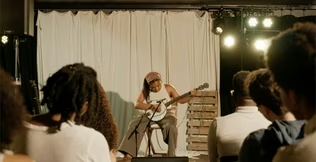
Clip: S11 Ep1106 | 1m 56s | A novice banjoist performs "Boil That Cabbage Down" at a celebratory jam session. (1m 56s)
Providing Support for PBS.org
Learn Moreabout PBS online sponsorship












Support for PBS provided by:
Support for Reel South is made possible by the ETV Endowment of South Carolina, National Endowment for the Arts, and Wyncote Foundation.